About In the Mouth of Madness
In the Mouth of Madness is John Carpenter‘s supernatural horror film starring Sam Neill as a cynical insurance investigator hired to track down a missing bestselling horror novelist named Sutter Cane – a writer so popular that his readers are literally losing their minds. The trail leads to Hobb’s End, a supposedly fictional New England town from Cane’s books that turns out to be very, very real. It’s the closing chapter of Carpenter’s informal Apocalypse Trilogy (alongside The Thing and Prince of Darkness), and it wears its H.P. Lovecraft influences proudly – not just the tentacle monsters, but the deeper Lovecraftian dread of encountering something that destroys your entire framework for understanding reality.
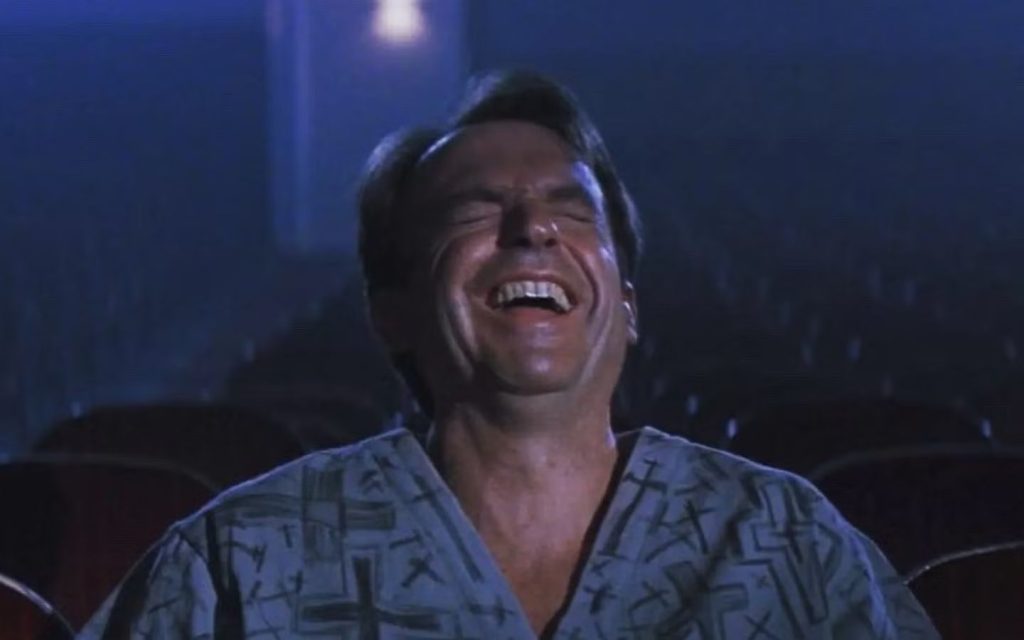
What sets it apart is the central horror concept: the idea that fiction, consumed by enough people, can reshape the world itself – and that the protagonist may be nothing more than a character in someone else’s story. It flopped on release, grossing less than $9 million, and critics mostly shrugged. In hindsight, it’s widely regarded as Carpenter’s last great film and one of the most genuinely unsettling meta-horror movies ever made. Sam Neill ends the film sitting in a cinema watching his own life play out on screen, laughing hysterically. It’s perfect.
Let’s celebrate In the Mouth of Madness by revisiting 21 Trivia Facts about this Cult Horror Hit!
1. Darth Vader was in this Film
In the Mouth of Madness starred numerous well known actors and actresses. Though none few are as iconic as Hayden Christensen’s appearance, which was also his feature film debut. Star Wars films will remember Christensen from his portrayal as an older Anakin Skywalker in Star Wars: Episode 2 and 3. Who eventually becomes Darth Vader.
2. In the Mouth of Madness is part of the Apocalypse Trilogy
In the Mouth of Madness is the third film in what John Carpenter called his Apocalypse Trilogy, the first being The Thing (1982) and the second being Prince of Darkness (1987).
3. There’s an Homage to John Carpenter’s Childhood
In the Mouth of Madness is an homage to John Carpenter’s childhood. In it, Robot Monster (1953), which Sam Neill is watching at the end of the movie, is one of director John Carpenter’s favorite monster movies as a kid.
4. Spinning Heads and How They Do It!
There are so many fun and downright creepy effects featured in In the Mouth of Madness.
The effect of Julie Carmen spinning her head around was done by having a contortionist stunt-double wear an up-side down prosthetic mask of Carmen’s face. Since the stunt double couldn’t see, the filmmaker had to guide her on where to go by sound.
5. Where they filmed the Mental Institution
In the Mouth of Madness wasn’t filmed in a Mental Institution as some might think.
The building used as the mental institution at the beginning of the film is actually a water filtration plant in the Beaches area of Toronto. It has been the scene of other movies, including the island fortress in Undercover Brother (2002). Filming can no longer take place inside this building following the September 11 terrorist attacks on the USA.
6. References to The Cthulhu Mythos
The Cthulhu Mythos is throughout this entire film.
References to the “Old Ones” by Sutter Cane, along with certain representations of monsters printed on his books are allusions to The Cthulhu Mythos – a series of stories by H.P. Lovecraft and continued by other writers into modern times.
In this sense, one could consider In the Mouth of Madness to be John Carpenter’s own contribution to The Cthulhu Mythos.
7. It’s about John Carpenter’s friendship with Horror Novelist Stephen King
John Carpenter used his friendship with Stephen King as inspiration for In the Mouth of Madness. Specifically, The Sutter Cane character is clearly based on John Carpenter’s friend, Stephen King, even referencing King’s New England roots, with Hobb’s End filling in for King’s Castle Rock.
Carpenter directed a film version of King’s Christine (1983). Additionally, Michael De Luca had previously written the screenplay for the King adaptation The Lawnmower Man (1987).
However, the characters say that Sutter Cane is even more popular than Stephen King.
8. The HP Lovecraft References
The HP Lovecraft quotes is a clear influence on In the Mouth of Madness. In the film, the works of Sutter Cane are occasionally quoted. Most if not all of these quotes are actually taken directly from several H.P. Lovecraft short stories with some adaptations to fit them into the film story.
Most notably, in the scene where Styles reads to Trent as he gazes into the abyss–her speech lifts much of its description, including such elements as “the illimitable gulf of the unknown” from the last few paragraphs of Lovecraft’s “The Rats in the Walls.” In an earlier scene as well, Trent reads a line verbatim from Lovecraft’s “The Haunter of the Dark,” in reference to the black church being “the seat of an evil older than mankind and wider than the known universe.”
The six Sutter Cane novels which Trent uses to track down the town of Hobb’s End are the following:
- “The Hobb’s End Horror”
- “The Feeding”
- “The Whisperer in the Dark”
- “Something in the Cellar”
- “The Breathing Tunnel”
- “Haunter Out of Time”
These titles are direct references to H.P. Lovecraft’s works, a direct inspiration for the movie.
Specifically:
- “The Dunwich Horror”
- “The Whisperer in Darkness”
- “The Rats in the Walls”
- “The Thing in the Doorstep”
- “The Shadow Out of Time”
- “the Haunter of the Dark”
Then there’s the title of the movie itself which refers to “At the Mountains of Madness”, yet another work of Lovecraft’s.
Finally, In the Mouth of Madness also contains many references to H.P. Lovecraft’s stories, for example, the Name of the hotel and hotel owner “Pickman”, a reference to the short story “Pickman’s Model”.
9. The Wall of Monsters
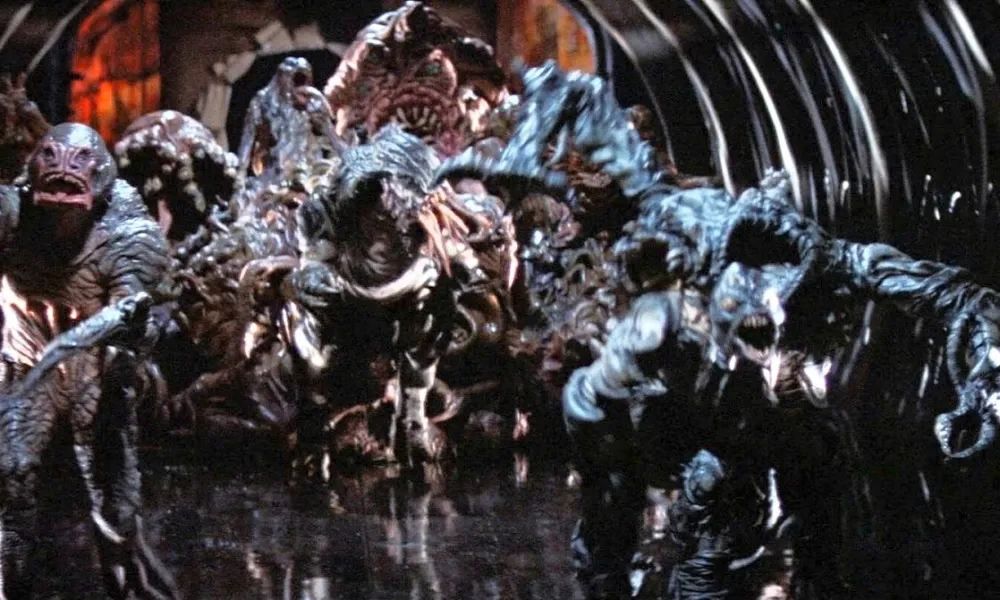
The “Wall Of Monsters” at the end wasn’t several monsters being controlled individually. Instead, it was one single special effect that was attached to a vehicle-like wheelbase and had to be pushed along with a crank. During the filming of this scene, the Wall of Monsters accidentally ran over Greg Nicotero’s foot and he had to be taken to a nearby hospital.
10. Literature References
Stephen King’s short story ‘Crouch End’ was published in the 1980 anthology ‘New Tales of the Cthulhu Mythos’, with a reworked version later appearing in King’s 1993 anthology ‘Nightmares and Dreamscapes’. In the story, a man and woman visit an English suburb called Crouch End, where they become stranded and are unable to leave. They are taunted, tormented and chased by a pair of deformed, otherworldly children, who later summon a Lovecraftian Old God. Some aspects of King’s Crouch End bear great resemblance to the film’s town of Hobb’s End.
11. The John Carpenter Cameo
John Carpenter has a brief In the Mouth of Madness cameo in the film as an asylum patient in the beginning of the movie. When Trent is shouting “I’m not insane!” throughout the asylum, the camera pans past Carpenter, who shouts “me neither!”
12. Stephen King versus HP Lovecraft
Who’s the bigger In the Mouth of Madness influence? Stephen King or HP Lovecraft?
Although, Sutter Cane might appear to be representative of Stephen King, he’s more likely to be based on H. P. Lovecraft, and Hobb’s End is based on Lovecraft’s Arkham rather than King’s Castle Rock. The plot of the film also more closely resembles something Lovecraft might have written, focusing on the effects that horrific occurrences have on one’s sanity, rather than on the external horrors that most of King’s writings lean towards. Even the title, “In the Mouth of Madness,” appears to be an homage to Lovecraft and his story, “At the Mountains of Madness.”
13. Sam Neill’s Accent
Despite In the Mouth of Madness being set in and with heavy reference to New York, Sam Neill speaks with his natural New Zealand accent, most notably when he says the word “them” in the opening of the film, emphasizing the “e” as an “I”.
14. Rutger Hauer was once considered for the role
Rutger Hauer (R.I.P.) was once considered for the role of Sutter Cane.
15. The Omen Saga Connection
David Warner played a photographer in Richard Donner’s The Omen (1976) with legendary actor Gregory Peck. Whereas, Sam Neill played Damien Thorn in Omen III: The Final Conflict (1981).
16. A Ghostbusters Actor Turns Up
In the Mouth of Madness stars a Ghostbuster!
Simon is played by Wilhelm von Homburg who also played the main antagonist Vigo in Ghostbusters II.
17. How did they do the Monsters at the end of In the Mouth of Madness?
The dozens of monsters featured towards the end of the film were a combination of men in suits, animatronics and a full-sized “wall” of creatures. It took over thirty people to operate the monsters.
18. Stuck In Cinematic Purgatory
At the end of the film, when Sam Neill approaches the movie theater showing the meta-film, the following credits can be seen (though some names are slightly blurred) on the movie poster outside the theater:
“New Line Cinema Presents John Carpenter Film ‘In the Mouth of Madness‘ Starring John Trent, Linda Styles, Jackson Harglow
Written by ‘Michael De Luca’
Associate Producer/Artist: W. Robinson
Director of Photography: Gary B. Kibbe
Production Designer: Jeff Ginn
Produced by Sandy King
Director: John Carpenter.”
Except for the three lead character names, all the other credits are for the real film’s actual crew.
19. The ‘Paper Tear’ Effect
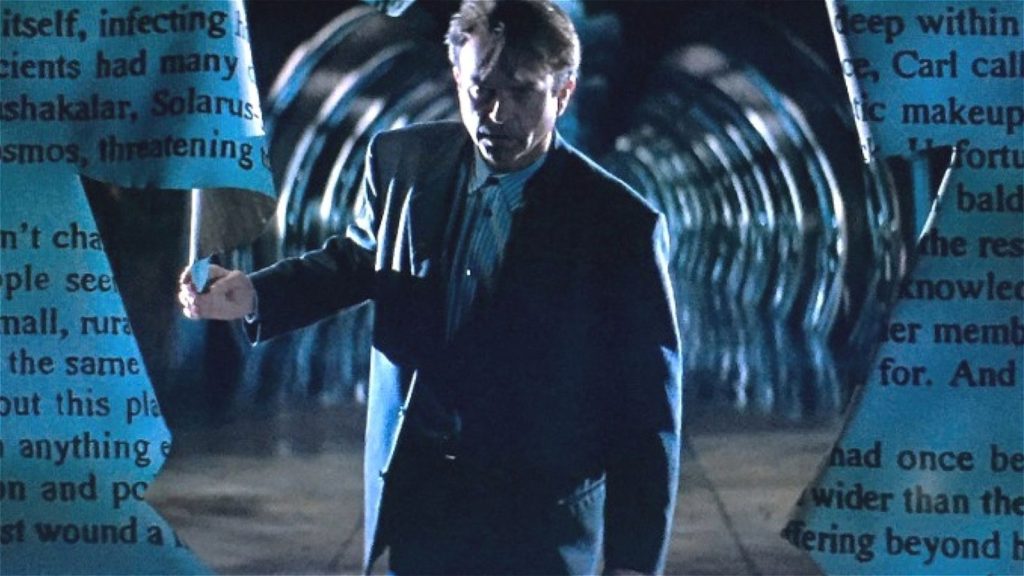
When Jürgen Prochnow lets the monsters from the other side into our world, originally in the script the entire town was sucked into the other side. When this proved to be too costly, an effects artist over at Industrial Light and Magic recommended that instead he “tears” himself apart like paper.
20. Hobb’s End is a Real Place… sort of
You can find Hobbs End… kind of.
There’s a map created from the book covers in In the Mouth of Madness. According to the map that the book covers create, Hobb’s End would be located at the edge of Loudon, New Hampshire, near the Merrimack/Belknap county line.
21. Why are everyone’s eyes Blue?
In the Mouth of Madness constantly reinforces the power and influence of fictional novelist Sutter Cane – both through referential dialogue and in horrific scenes.
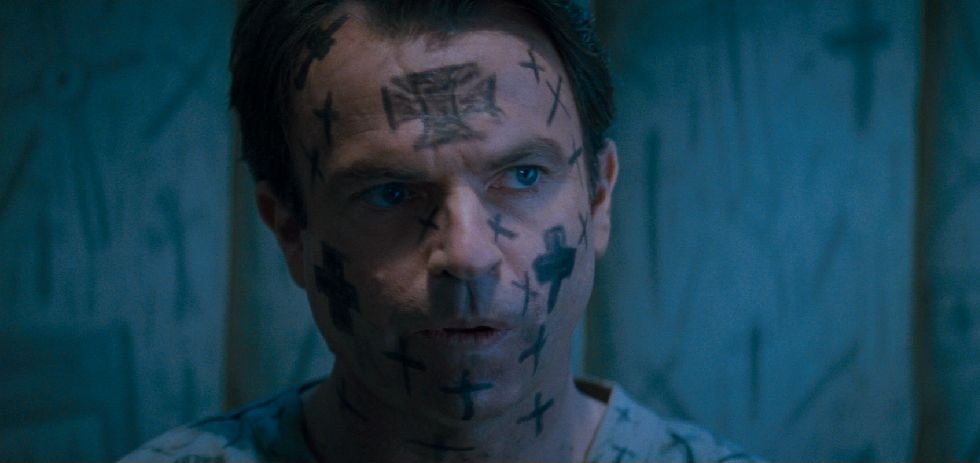
After Sutter Cane says “Did I ever tell you my favorite color is blue?” It is realised that throughout the entire movie, whenever an actor has a close up, their eyes are blue, proving Sutter Cane’s power.
Did you pick up on all of these In the Mouth of Madness Trivia?
What’s your favourite bit of In the Mouth of Madness trivia?
Let us know in the comments.