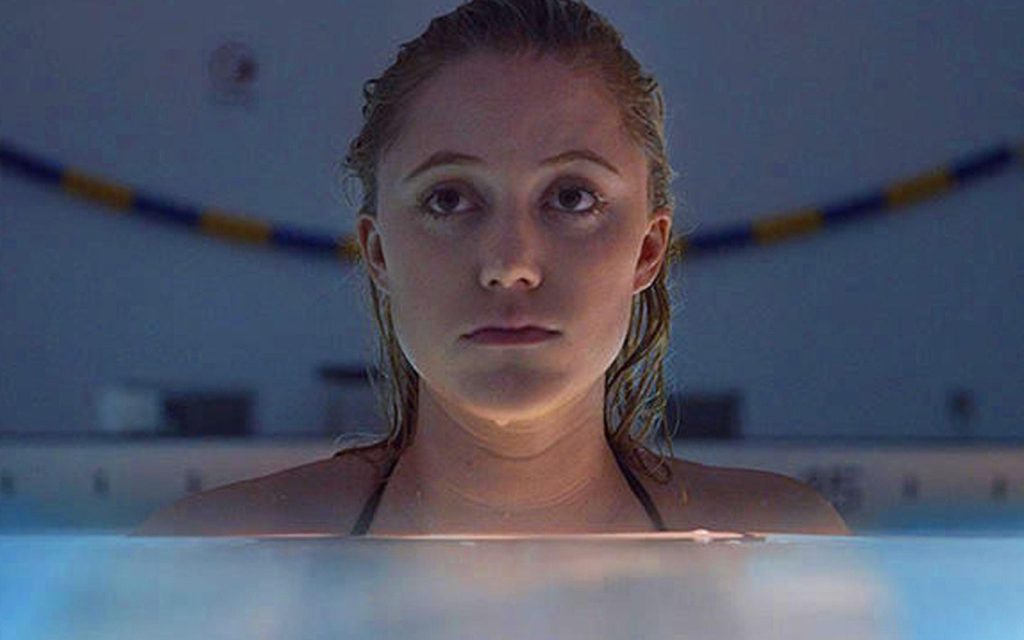
The Inescapable Terror of the It Follows Score
A Critical Dissection of Disasterpeace’s Sonic Predator
There’s a very specific kind of fear that doesn’t need a face. It doesn’t leap out from the dark or howl into the night. It doesn’t even bother speeding up when you run. It just walks – slow, steady, inevitable. And before you even spot it, the sound of it has already crept into your bones. That’s the kind of terror composer Disasterpeace (real name: Rich Vreeland) built into the bloodstream of It Follows.
You can turn off the lights. You can close your laptop. But that pulse, that low-frequency, half-digital throb? It’s still there. It’s still following you.
A Monster Without a Mouth
Most horror scores shout. They lunge, stab, or claw at you with orchestral hysteria – strings shrieking, brass blaring, percussion detonating in the dark. But It Follows does the opposite. It whispers in binary.
The score is stripped bare: a lattice of synths, pulses, and corrupted data. There are no swelling violins, no tear-jerking crescendos. Just an endless, mechanical heartbeat that refuses to die. From the opening cue “Heels” to the closing “Title,” Disasterpeace constructs a kind of digital organism that doesn’t accompany the film’s monster – it is the monster. Every tone, every tiny modulation, acts like a footstep in pursuit.
When the movie’s cursed entity begins its slow-motion pursuit of protagonist Jay (Maika Monroe), the audience doesn’t need to see it. The sound alone is enough. Disasterpeace turns frequency into fear, transforming a minimal synth setup into something alive, breathing, and disturbingly aware of you.
The Pulse of Inevitability
Let’s start with that square wave pulse – the bedrock of the entire score. It’s simple, crude, and brutally effective. Running at roughly 100 BPM, it’s too slow to dance to and too fast to ignore. It sits just low enough in the mix to mimic a human heartbeat but with none of the warmth or texture of life. It’s synthetic biology—a digital approximation of something vital, only wrong.
The rhythm never resolves, never softens, never fades completely. Like the curse itself, it just keeps moving. The repetition, far from monotonous, becomes ritualistic. After thirty seconds, it stops sounding like music and starts feeling like existence – a reminder that your own body, your own pulse, is just another loop waiting to be broken.

Disasterpeace’s mastery lies not in what he adds, but in what he withholds. Each repetition carries micro-variations – tiny, nearly imperceptible shifts in pitch, filter cutoff, and decay time. Your conscious mind hears stability; your subconscious detects movement. The loop walks toward you.
In evolutionary terms, this is genius. Humans are hard-wired to notice small, inconsistent patterns in sound—it’s how we survived predators long before Spotify existed. Disasterpeace exploits that neural quirk, turning every five-percent dip in sustain, every quarter-tone shift, into a primal alarm bell. You don’t know why you’re uneasy, you just are. The score has hacked your lizard brain.
The Sound of Being Followed
Spatial manipulation plays a silent but devastating role here. On the cue “Heels,” that heartbeat isn’t centered. It drifts, slightly left of frame. Sometimes it slides right. But it’s never balanced.
A perfectly mixed stereo field would feel static, safe, predictable. Disasterpeace doesn’t allow that. He weaponises imbalance. Through careful stereo imaging, he positions sounds just enough off-center to make you feel stalked within your own headphones. The effect is subtle – like someone walking one step behind you, always close enough to touch, never close enough to catch.
If you’ve ever listened to It Follows on good headphones, you’ll know that sensation: that phantom hand brushing past your shoulder. That’s no accident. It’s the score creating proximity terror, a kind of auditory claustrophobia that mirrors the film’s visual language – wide shots, endless empty spaces, and something always approaching.
Breaking the Body Clock
Most film scores are locked to the film’s edit – a rigid BPM grid that syncs every cue to a cut or camera move. Disasterpeace broke that convention completely. Director David Robert Mitchell reportedly cut the film without any temp music, giving Vreeland the freedom to compose organically, letting the scenes breathe.
This freedom meant Disasterpeace could drift tempo, ever so slightly, across scenes. You won’t notice it consciously, but your body will. The tempo might stretch by two BPM here, compress by one there, throwing off your internal metronome. Your sympathetic nervous system can’t find a rhythm to rest against.

That physiological disorientation – your pulse chasing a tempo that keeps slipping away – becomes the real horror. Your body wants to sync, to predict, to survive. But It Follows denies you that. There’s no release, no catharsis. Just constant low-grade panic.
In effect, the score mimics the monster’s logic: no matter how fast you run, it will always adjust, always adapt, always catch up. The music isn’t chasing the picture; it’s stalking it.
Silence as Punishment
In traditional horror scoring, silence is a reprieve. A moment for the audience to breathe before the next big scare. Disasterpeace weaponises it instead.
When he withholds sound, he doesn’t offer calm – he offers void. The score often drops out entirely, leaving you stranded in pure ambient unease. The absence of music feels heavier than the music itself.
This refusal to grant emotional release mirrors the film’s nihilism. There’s no escape from the curse, no tidy moral closure. Even sex – the supposed ritual to pass the burden – offers no salvation. The silence following those scenes feels punitive, like the sound has turned its back on you.
Dissonance: The Sound of Wrongness
Critics sometimes call the score “noisy,” but that undersells its precision. It’s not noise per se – it’s controlled wrongness. Disasterpeace builds his dread not through volume but through harmonic sabotage.
He leans heavily on tritones – the “devil’s interval” of Western music – along with minor ninths and detuned oscillators. These intervals never fully resolve, leaving you hanging in a state of suspended anxiety. It’s like walking down a flight of stairs and missing the last step, over and over again.
Unlike the clear key structures of John Carpenter or Goblin, Disasterpeace deliberately avoids tonal centers. You think you’ve found the root, then it slips away by a minor third. It’s harmonic gaslighting. Your ear keeps searching for home, but home keeps changing locks.
This is more than just clever composition – it’s psychology. Neuroscientists call it a Schoenberg moment: when your brain can’t identify a tonal anchor, it experiences genuine spatial disorientation. In other words, you get lost. It Follows makes you lost on purpose.
Timbral Dissonance: When Sound Eats Itself
What truly sets Disasterpeace apart from the synthwave imitators who followed in It Follows’ wake is his obsession with timbral dissonance – the battle inside the sound itself.
Two oscillators might play the same pitch, but one will flicker between square and triangle waves while the other shifts between saw and sine. They share amplitude, so your ear reads them as one, but their harmonics keep diverging. The result is a sound that constantly de-tunes itself, like it’s melting in real time.
It’s a sonic mirage: stable at a glance, diseased on closer inspection. You can feel it in your teeth. It’s the aural equivalent of seeing your own reflection blink before you do.
The technical term might be “bit-crushing,” but in It Follows it feels more like soul-crushing. Disasterpeace lowers sample rates to 12-bit or less, causing the sound to glitch and decay, like corrupted data on a dying hard drive. What should be clean digital tone becomes an infected waveform, an aural metaphor for the film’s sexually transmitted curse – decay masquerading as desire.
Loudness as Suffocation
Modern horror often thrives on the quiet-quiet-loud formula: tension builds in silence, then breaks with a jump-scare burst. Disasterpeace refuses to play that game.
It Follows opens loud and stays loud. The dynamic range is compressed, suffocating you within an 80 dB ceiling that feels inescapable. There are no peaks or valleys, no auditory landmarks to guide you out. It’s a constant pressure chamber of dread.
It’s the sonic equivalent of claustrophobia – an unrelenting density that grinds the nerves down through sheer consistency. The tension doesn’t spike because it never dips.
This flattening of dynamics turns the entire film into a single, continuous panic attack. Your body begs for contrast – a whisper after the scream, a rest after the throb – but the score just keeps walking.
The 80s Nostalgia Trap
The biggest trick It Follows plays on its audience is one of betrayal. Because when you hear those lush, retro synths – the warm, reverb-drenched tones of a vintage Juno – you expect safety. You expect John Carpenter, Vangelis, maybe even Stranger Things.
Disasterpeace knows that. He builds that comfort deliberately, lets you sink into the neon glow for a heartbeat or two… and then he poisons it.

Two bars in, he drops a tritone into the progression. The synth that once sounded like childhood suddenly sounds like corruption. Nostalgia curdles into menace.
This is weaponised nostalgia – the idea that our collective love for analog warmth can be used against us. It’s a horror uniquely suited for the millennial psyche, where every sound of comfort (the hum of CRTs, the VHS fuzz, the arcade synth loop) can become an auditory haunt from the past.
In that sense, It Follows is a cultural haunting. It turns the familiar into the uncanny, the retro into the rotten.
The Carpenter Comparison
You can’t talk about It Follows without invoking John Carpenter, the godfather of minimalist synth horror. Carpenter’s Halloween theme, with its clean 5/4 piano motif and stoic synth pulse, practically invented the modern horror soundscape.
But where Carpenter’s synths offer control – an architect’s blueprint of dread – Disasterpeace’s synths suggest entropy. Carpenter’s themes guide you through the nightmare; Disasterpeace’s infect you with it.
In Carpenter’s world, the monster can be confronted. In Disasterpeace’s, it’s already inside the sound.
The difference is philosophical: Carpenter scores the chase, Disasterpeace scores the infection. One externalizes fear, the other internalizes it. And once internalized, it’s almost impossible to purge.
Sound Design as Storytelling
At its core, It Follows is about inevitability – about the horror of consequences that can’t be escaped or undone. Disasterpeace translates that theme into sonic architecture.
Every choice reinforces the narrative:
- The endless looping pulse mirrors the curse’s persistence.
- The lack of resolution mimics the characters’ moral and physical limbo.
- The bit-crushed decay mirrors the loss of innocence.
This isn’t score as decoration; it’s score as embodiment. The music doesn’t just underscore the monster – it is the monster’s voice, its breath, its gaze.
When the film cuts to silence, it’s not peace – it’s the moment the entity stops hiding. When the pulse resumes, it’s your heartbeat resuming after you’ve realized you were holding it.
The Psychology of Fear Frequencies
Beyond the artistry, there’s science here too. Disasterpeace exploits psychoacoustics – the way certain frequencies physically unsettle the body.
Low-end pulses between 30–60 Hz can trigger unease because they mimic the body’s natural fight-or-flight resonance. Midrange dissonance (around 400–800 Hz) agitates the auditory cortex, the same range as a baby’s cry or a warning siren. Disasterpeace stacks these frequencies deliberately, creating a physiological unease that no visual jump scare could match.
It’s why the score gets under your skin. It’s not just music – it’s neurological manipulation.
Legacy: The Score That Won’t Stop Following
A decade on, It Follows remains one of the most studied horror scores of the 21st century. Its influence seeps into everything from Stranger Things to The Guest, from indie horror trailers to synthwave revival albums. But few successors have captured its precision.
Where others imitate the sound, Disasterpeace’s genius lies in the intent. His score doesn’t mimic Carpenter – it interrogates him. It asks: What if the very language of horror music could become the monster itself?
Every bar of It Follows answers that question with another pulse, another step, another reminder that dread doesn’t need teeth – it just needs persistence.
The Endless Loop
All in all, when you strip away the analysis, the theory, the knob-twisting wizardry, you’re left with something brutally simple: a sound that refuses to stop.
That’s the real horror of It Follows. The monster never sprints. The score never climaxes. The fear never releases. It just keeps walking, one beat after another, across the theater, through your headphones, into your dreams.
Disasterpeace created more than a soundtrack – he created a presence. A sonic entity that loops indefinitely, waiting for you to listen again. Because the moment you do, it starts over.
You might not see it coming. But you’ll hear it.
And by then, it’s already too late.